
Abstract
Political gerrymandering, the practice of drawing voting districts to the advantage of the party in power, has been routinely performed in the United States for more than 200 years. In addition to giving one party an unfair advantage, it makes districts non-competitive, promotes political polarization, and raises genuine doubt among the populace that the political system is fair.
Congress and the courts have been involved in the redistricting process, but their impact has made the process arguably less fair. The 1965 Voting Rights Act, enacted to guarantee enfranchisement to minorities, mandates racial gerrymandering whenever possible, but has unfortunately limited minority influence by restricting them to a single district. Furthermore, the courts have interpreted the Equal Provisions Clause of the Fourteenth Amendment so narrowly that states are pushed to create precisely equal sized districts, allowing politicians to become heavily involved by dividing districts in advantageous ways.
The 1965 Voting Rights Act is the law of the land and will not likely be revoked. As such, minority-majority districts must be drawn. However, all other districts can and should be drawn based on the principles of compactness, contiguity, or equality of population within 1 to 2 percent. This methodology could be done efficiently through computer optimization, which can be achieved quickly, fairly, and at substantially lower cost than the current system. Making this change would benefit the entire country.
End Political Gerrymandering
Political gerrymandering is the process of drawing the boundaries of districts within a state to benefit the political party in power. This practice has been employed by elected officials in the United States since the earliest days of our republic and has proven to be destructive to the political system.
In its simplest form, gerrymandering creates the largest possible number of political districts that will vote for the party in power. Primarily, the practice is accomplished using two different methods, “packing” and “cracking.” “Packing” involves concentrating voters of the opposing party, race or ethnicity into a single district so that the opposing influence will be contained. In contrast, “cracking,” involves diluting opposition supporters across many districts so that the opposing influence is negligible. Widely viewed as a form of political corruption, Gerrymandering accomplishes the following:
- Allows the majority party to unfairly stay in power.
- Makes districts non-competitive, so that office holders can hold a position for decades, and in some instances, a lifetime.
- Promotes political extremism by tailoring a district to the election needs of the politician running for office. A politician with potentially outrageous views can hold office with little chance of being seriously challenged.
- Allows politicians in power to seek retribution against others, by redrawing a political district to deny an individual of an opposing party any chance of being elected.
- Raises genuine doubts among the electorate that the political process is fair.
The effects of unfair and biased political gerrymandering are almost universally acknowledged, and the U.S. Federal Government has become involved in the redistricting debate. However, previous attempts at finding a redistricting solution have proved ineffective, and gerrymandering continues unabated. It is time to stop this practice! This paper suggests a clear and logical redistricting methodology that allows for creating compact, equitable districts without political interference. However, before discussing this promising unbiased methodology, some historical background is useful.
The History of Gerrymandering
Even before the term “gerrymandering” existed, it was common practice for politicians to manipulate voting districts to create a political advantage. As far back as 1788, Virginia Governor Patrick Henry drew a district that he believed his adversary James Madison could not win. The stakes were high. Henry, an Anti-Federalist, wanted to keep power at the State level, whereas Madison wanted to draw up a new powerful Federal Constitution. Madison prevailed and beat Henry’s choice, James Monroe, in the only Congressional election in which two future Presidents opposed each other. It is worth noting that the redistricting conflict between Patrick Henry and James Madison occurred more than twenty years before the term “gerrymander” was created.
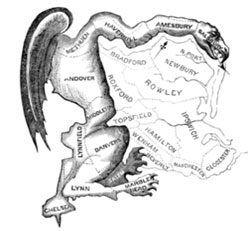
The actual term “gerrymandering” was coined in 1812, when Massachusetts governor Elbridge Gerry signed a bill that redistricted Massachusetts to empower his own Democratic-Republican Party. When a re-drawn district in the Boston area, instead of being compact, appeared in the shape of a salamander (see Figure 1), the term “gerrymander” was born, as a composite of “Gerry” and “salamander.”
The Courts and the Equal Population Requirement
For most of the nation’s lifetime, redistricting was considered solely the domain of individual states and Federal courts played no role. The state authority over redistricting changed in 1962 when the Supreme Court in Baker v. Carr ruled that Federal courts had jurisdiction regarding the constitutionality of state districting plans. Soon thereafter, the courts dove into the problem of population equality of districts.
In the landmark case of Wesberry v Sanders, 367 U.S.1 (1964), in which one district in Georgia had three times the population of another, the Supreme Court ruled that congressional districts in each state must have equal population “as nearly as practicable.” Therefore, if a state had 7 million citizens and 10 congressional districts, each district must have 700,000 inhabitants “as nearly as practicable.” Unfortunately, the Supreme Court failed to precisely define the term “as nearly as practicable”, and subsequent court decisions interpreted the term exceedingly narrowly.
In the case Karcer v. Daggett (1983), the U.S. Supreme Court affirmed a district court decision that struck down a New Jersey congressional plan that deviated from the ideal-sized district by an average of 0.138 percent. In other words, if a state with an average district size of 700,000 draws any district with 700,966 people, it would be considered illegal because the population variance is too great. The ruling had huge impact on state legislatures.
Today, of the 43 states that contain more than one congressional district, 32 states have drawn districts with deviations of no more than four individuals, and 28 states have drawn districts with a deviation of no more than one individual. Oddly, the courts are not nearly as strict with state legislatures, allowing a 10 percent population variance.
Although congressional districts should be similarly sized, the logic of demanding identically sized districts makes no sense because births, deaths and population migration cause district sizes to change quickly. Within a week, districts are no longer sized identically. Within 10 years, there are large disparities.
Furthermore, congressional districts vary widely in size from state to state across the country. The average size of a congressional district based on the 2010 Census apportionment population is 710,767. However, because of the different populations and number of congressional seats, Wyoming, for example, has an average district size of 536,626, whereas Idaho has an average district size of 783,791.
Moreover, the consequence of demanding exactly equal districts within a state can provide political outcomes that are lethal to the electorate process in that state. Nearly all state legislatures and redistricting commissions draw plans from census data, the smallest unit of which is the census block, with an average population in 2010 of 49 people. To create exactly equal districts, the court sanctions state legislatures to redline individual streets or dwellings to go to one district or another based on the needs of the legislators and the political party. This redlining practice takes gerrymandering to the extreme. For example, one district in North Carolina successfully split a college dormitory into two separate districts.
Data on voter registration and voting patterns is easily obtainable, and it is simple for officeholders to determine which voters will give them the best chance of reelection. The court system has rubber stamped this process, and if it is not reversed, political candidates will continue to select their own voters, rather than allowing the voters to select their political candidates.
The Courts and Minorities
For many years, gerrymandering was used as a tool to disenfranchise minorities. Although the 15th Amendment granted the right to vote for adult African American males in 1870, there were few mechanisms in place to enforce this decision. Some states evaded the law by employing poll taxes and literacy tests, and others simply disregarded court orders without penalty. These unfair practices changed when the 1965 Voting Rights Act was passed, which prohibited all voting practices and procedures that discriminated based on race and specific “language minority groups,” defined as Asian Americans, Hispanics, Native Americans, and Native Alaskans. Currently, courts use the Equal Rights provision of the Voting Rights Act as a primary method to test if racial gerrymandering exists.
Particularly important is Section 2 of the Voting Rights Act, amended in 1982, which mandates drawing a congressional district around a minority group if that group can equal 50 percent or more of the population. A 2009 case, Bartlett v. Strickland changed the requirement slightly, to 50 percent or more of the voting-age population.
In Thornburg v. Gingles (1986) the Supreme Court ruled that a so-called “minority-majority” district must be drawn if:
- The racial or language minority group “is sufficiently numerous and compact to form a majority in a single-member district.”
- The minority group is “politically cohesive,” which denotes that the group votes similarly.
- The “majority votes sufficiently as a bloc to enable it…usually to defeat the minority’s preferred candidate.”
Theoretically, the purpose of this “minority-majority” ruling is to ensure that minorities are fully enfranchised. However, in practice, it does the opposite. “Packing” minorities into a single district is a classic strategy of racial gerrymandering and is done to contain minority influence, not expand it. Ironically, this interpretation conflicts with the Equal Protection Clause of the 14th Amendment, which, according to the Supreme Court “prohibits a state, without sufficient justification, from separating its citizens into different voting districts on the basis of race.” A secondary consequence is that the “chosen” candidate of the minority-majority district will always have a “safe” seat and will be able to keep his or her job without fear of being dislodged for any reason by voters.
The Voting Rights Act was passed in 1965, at a time when many believed that minorities could not be elected to office unless their constituents were also minorities. Originally set to expire in five years, the Voting Rights Act was renewed in 1970 for five years, renewed in 1975 for seven years, renewed in 1982 for ten years, renewed in 1992 for 25 years and renewed in 2006 for 25 years. The situation is a legislator’s conundrum. If in the year 2021, it is still impossible for a minority to be elected to office without minority majority representation, the Voting Rights Act is an abject failure and should be repealed or replaced. Instead, legislators argue that the legislation is working, but at a snail’s pace, so that it must be continually renewed for longer and longer periods of time.
There is little reason for Representatives and Senators in Congress to oppose renewal of the Voting Rights Act because its provisions benefit officeholders of each party. Democrats can emphasize that racism is paramount in the United States, and Republicans benefit by placing liberal voting blocks within a single district, greatly minimizing their reach. The main result is that the Voting Rights Act protects incumbents and segregates and polarizes the electorate. When the Voting Rights Act was last renewed in 2006, it prevailed by a vote of 98 to 0, ensuring legislation that was originally scheduled to expire in five years will continue for at least 76 years.
Landmark Supreme Court Case – Rucho v. Common Cause
In 2019, in a five to four decision, the Supreme Court ruled that individual States and the U.S. Legislative Branch, not the Federal Courts, should police partisan gerrymandering. Chief Justice Roberts, writing for the majority stated, “we conclude that partisan gerrymandering claims present political questions beyond the reach of the Federal Courts.” In short, the Supreme Court washed its hands of the issue.
The Supreme Court ruling combined two cases, Rucho v. League of Women Voters of North Carolina, where Republicans tried to pack as many Democrats as possible into three districts, and Lamone v. Benisek, where Maryland Democrats re-drew state districts to eliminate one of the two Republican districts. Partisan gerrymandering was freely admitted to in both cases. Former Maryland Governor Martin O’Malley acknowledged that new lines were drawn to “create a district where the people would be more likely to elect a Democrat than a Republican, yes, this was clearly my intent.” Republican chairman of North Carolina’s redistricting committee, David Lewis, was equally transparent, stating “I propose we draw the maps to give an advantage to ten Republicans and three Democrats, because I do not believe it is possible to draw a map with eleven Republicans and two Democrats.”
The upshot of these cases and the Supreme Court ruling is that, unless Congress or the American electorate take control, majority parties will continue to draw districts to their advantage for the foreseeable future. Throughout the history of the United States, Congress has shown relatively little interest in reforming political gerrymandering, so the practice will likely continue unfettered unless the states act.
Although the Supreme Court ruled that political gerrymandering was beyond its reach, Federal Courts still maintain jurisdiction over racial gerrymandering, and the “majority minority” precedent they set, even with the damage this causes by minimizing minority voter political clout. Furthermore, the ruling that Congressional Districts must be drawn exactly even in size is unaffected and unchallenged.
State Redistricting Principles
As discussed earlier, Federal law applies the following principles for state redistricting plans, the first is equal protection and the second is race and language minority status. Both principles encourage gerrymandering and racial “packing,” which dilutes the voting influence of minorities.
In addition, each state has the authority to define its own guidelines for redistricting. The two most common state guidelines make a great deal of sense. The first, “Contiguity” recommends that a district must be a single entity with unbroken boundaries, and the second, “Compactness,” recommends that redistricting should strive to keep the circumference of the district as small as possible. Unfortunately, these guidelines are often ignored. States still create winding, serpentine districts.
In addition, many states have added their own districting criteria, much of which are counterproductive to a free society. For example, some states have included guidelines that newly drawn districts must maintain their previous core, possibly to resist changing the redistricting process, but more likely to guarantee that incumbent politicians will be able to keep their positions for as long as they choose.
These varied state guidelines are toxic to the American electorate. It is not surprising that the number of competitive Congressional Districts, defined as elections won with less than 55 percent of the vote, has declined precipitously since the 1950’s. As a result, incumbent Congressmen are reelected approximately 95 percent of the time, while ironically, Congressional approval rates hover at 20 percent. Though polls indicate that Americans are increasingly repelled by Congress, Congressional Districts are drawn in such a way that make it nearly impossible to mount a serious challenge to sitting officeholders.
Examples of Outrageous Gerrymandering
Although a huge number of the nation’s 435 Congressional Districts are manipulated for partisan advantage, the following examples of existing districts highlight how egregious gerrymandering practices have become.
Example #1 – Maryland’s Third District
Maryland is among the most gerrymandered states in the U.S. and Maryland’s Third District may be the least compact in the country (see Figure 2). Described by a Federal judge as a “broken-winged pterodactyl, lying prostrate across the center of the state,” the district was drawn to favor Democratic candidates after the 2000 and 2010 census.
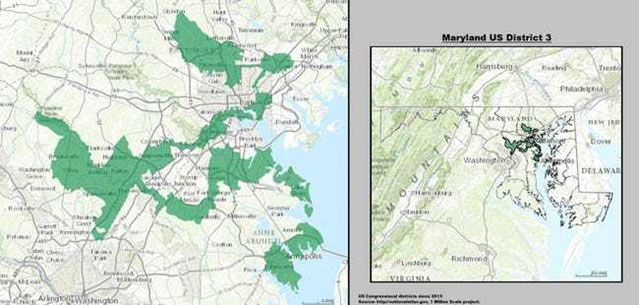
The normally liberal Washington Post said the districting profile in Maryland’s third district resembled “a blood spatter from a crime scene.” Although both Democratic and Republican political parties practice gerrymandering to protect their interests, Maryland Democrats have been extraordinarily aggressive and hard-hitting, and have actively cut and spliced districts to oust Republicans candidates. In 2020, just one Republican-held district remains in the state.
Example #2 – Ohio’s Ninth District
Ohio’s long, narrow snake-like ninth district begins in Cleveland, hugs the coast of Lake Erie and winds its way to Toledo and the Michigan border (see Figure 3).
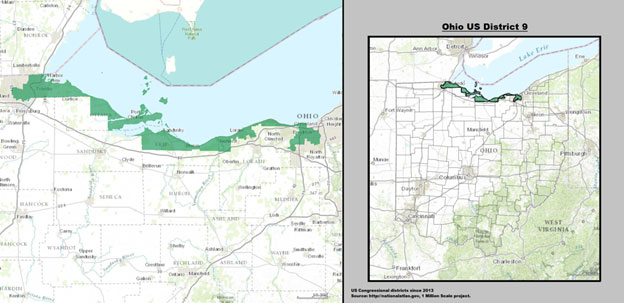
The area in Ohio’s ninth district is so narrow in spots that if the water level rises higher in Lake Erie, legislators fear that the district will no longer be contiguous. Designed by Republicans to pack Democrats into a single district, the redistricting scheme forced two incumbents living more than 100 miles apart to compete for a single seat.
Example #3 – Illinois’ Fourth District
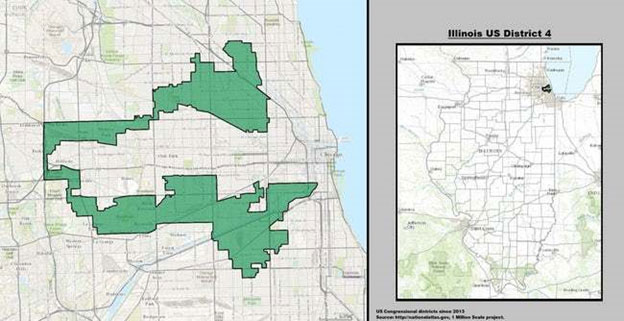
Drawn in the center of Chicago as a minority-majority Spanish-speaking area, this U-shaped district connects two detached areas by a single highway, and the remainder of the Latin community is “cracked” across several districts (see Figure 4).
Redistricting Principles Without Politics
When considering a viable and unbiased solution for the gerrymandering dilemma, it is necessary to examine some of the ground rules that would ensure an impartial, effective way to solve redistricting biases. The ability to stop gerrymandering will help ensure that the American elections have more bipartisan and unbiased outcomes. The following redistricting principles are worth considering:
- District Sizing – Congressional districts should have populations deviating no more than 1 to 2 percent. Districts cannot and should not be drawn exactly sized. The benefits of having exact populations have been overstated and illusionary. As noted earlier, districts quickly vary in size, no matter how well-intentioned their formation. Furthermore, this practice allows partisans to manipulate political maps to their advantage at the most miniscule level possible, when they should not be doing so at all.
- Minorities – Racial and language minorities should not be segregated into their own districts because this practice dilutes their political reach.
- Incumbents – Districts should not be drawn around populations supporting political incumbents because this practice guarantees that the incumbents will be unseated only with great difficulty. Congressional Representatives should be elected, not anointed.
- Contiguity – Districts should be contiguous.
- Compactness – Districts should be compact. Redistricting should strive to keep the circumference of each district as small as possible. Of all these redistricting principles, compactness is possibly the most crucial and has been routinely accepted by the courts as a plausible and fair method of redistricting.
Implementing these redistricting principles can be done concisely through computer optimization. Mixed integer programming can provide an optimal solution for state redistricting given multiple constraints. For example, one could take any state and, given the number of congressional districts allotted, divide the state into the most compact, contiguous districts possible, to an equal population within 1.5 percent.
Imagine a system where, once the national census results are in, districts would be automatically drawn to the desired constraints, without politics coming into play. This computer optimized approach to redistricting can be done more economically than the current system and would sidestep political bias because partisans would not design it. Computer optimized redistricting would offer clarity, simplicity and the fairness that is desperately needed. The results would be exactly as defined: Equal, contiguous, compact districts, drawn to favor no one, to everyone’s benefit.
Computer Optimization – A Test
To test the value of Computer Optimization, Virginia was selected to illustrate the effectiveness of this unbiased methodology in the redistricting process. The traditional practices that Virginia uses for redistricting are similar to those applied in other states; however, while Virginia’s gerrymandering efforts are arguably less outlandish than many, legislators clearly manipulated the map to their own benefit.
The University of Virginia Center for Politics christened the 2012 Congressional Redistricting Plan the “incumbent protection map.” This mapping scheme was most obvious in Virginia’s District 11, represented by Democrat Gerry Connolly. After Connolly barely scraped by in his 2010 election with a 49.2 percent to 48.8 percent plurality, District 11 was redrawn in a way that was distinctly more Democratic. After the redistricting, Connolly began winning comfortably, and by 2016, he ran unopposed, taking away any chance of constituents unseating him, or even differing with him.
The Virginia 2012 Congressional Redistricting Plan was challenged in the Virginia courts multiple times. However, the courts argued that the real redistricting issue was racial gerrymandering, not the incumbent advantage. At the point of contention were the Congressional Districts 3 and 4. In the original 2012 map, the District 3 was a true majority-minority district, with a 56 percent African American voting age population, up from 53 percent in 2000. Meanwhile in the neighboring District 4 the black voting age population declined slightly from 34 to 31 percent. As a result, Democrats sought to move some black voters from the District 3 to District 4 to help black and/or Democratic candidates in the fourth district. A three-judge panel ruled 2 to 1 that this strategy was reasonable, that racial gerrymandering had occurred, and that the districts should be redrawn. Interestingly, the one dissenting judge argued that race was not a factor in the Virginia plan, and that legislators simply drew the map to protect incumbents, which was legal.
Although outside the scope of this paper, it would be remiss not to mention that gerrymandering in the Virginia State Legislature was truly egregious. Eleven House of Delegates Districts were judged as gerrymandered, and legal costs, paid by the taxpayer amounted to more than eight million dollars. If states adopt an unbiased and logical computer optimization method of redistricting, these court cases and associated costs could be totally avoided.
The Congressional District map in 2012, based on the 2010 U.S. Census, is shown in Figure 5.
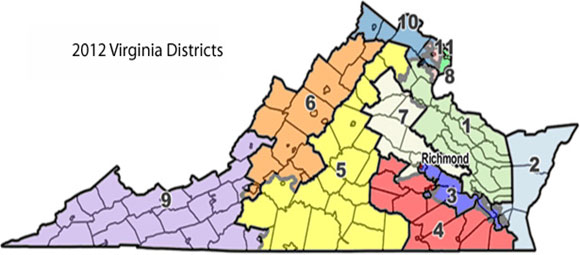
One can still see obvious political gerrymandering in the 2012 map. Notice that District 5 stands out because it begins at the rural North Carolina border and reaches up with a long finger all the way to the outer Washington DC suburbs. District 5 is neither compact nor cohesive, and it combines two areas with a vastly different economic bases. Although this map was changed later with the intervention of the courts, it illustrates how the districts were drawn by legislators without outside interference.
To see how the map would change if computer optimization was employed, Encore Data, Inc. worked with Optimization Direct, Inc. to develop a program that optimizes Congressional Districts based on the unbiased redistricting principles explained earlier in this paper.
The computer optimization model was built using census tracts. Census tracts are a larger geographic area designated by the Census Bureau, and typically contain 4,000 individuals, where a census block has an average population of 49. Thus, each census tract may, on average, contain approximately 80 census blocks. Even using the larger census tract as a building block, a population variation constraint of plus or minus 1.5 percent was easily met. The results are illustrated in Figure 6.
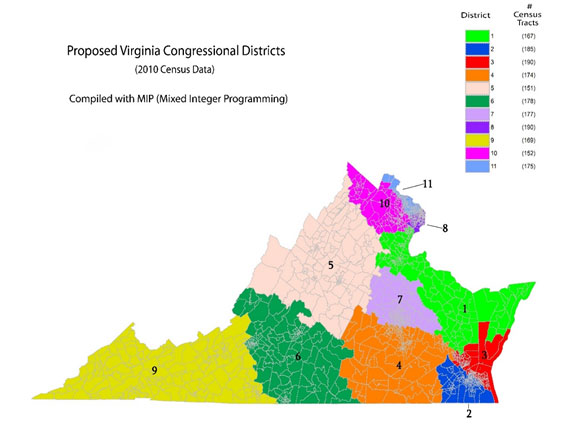
One can see that Congressional Districts 2, 3, 4, 5 and 6 are visibly more compact than in the adopted map. District 5, especially, is more contained and no longer stretches the length of the state.
Action Plan – 2021
In late 2021, the U.S. Census results will be sent to the states and the redistricting process will once again begin. If redistricting is implemented the same way that it has been over the past five decades, the politically biased results will remain the same. Majority parties will rule the day and will carve up states to meet their own personal and political ambitions. Racial minorities will be segregated and polarized, their influence will be restricted, and they will be unable to vote their representatives out of office without enormous difficulty. Indeed, if gerrymandering efforts are truly successful, there will be no need for anyone to vote in any state election, because the outcome will be decided before the first vote is cast. Politicians will continue to have the power to choose their constituents instead of the other way around.
The outrage of the American electorate is palpable. Some of issues can be solved immediately, but others cannot. Practically speaking, the Voting Rights Act of 1965 will remain law for the foreseeable future, and minorities will continue to be packed into single districts. However, as a first step we suggest the following:
- Draw majority minority districts as currently mandated by law.
- For all other districts, employ unbiased computer optimization to draw contiguous, compact districts with equal populations that allow for a more reasonable 1 to 2 percent variance. This should be done at both at congressional and state legislative districts.
In addition to removing politics as much as possible from the redistricting process, the cost savings to the state would be substantial.
For the future of the United States and the importance of fair and ethical elections, it is critical for every state to ensure that every American’s vote matters, and that all votes are equal. This cannot occur if political gerrymandering continues.
####
About Encore Data
Encore Data is a data analytics firm based in Reston, Virginia.
About Optimization Direct, Inc
Optimization Direct, based in Hannington Park, New Jersey, created the first integrated development environment for optimization.
For More Information:
If you would like more information about optimized redistricting, or if you would like a free cost estimate, please contact Ann Stephens at astephens@encore-data.com.